

Choosing a Custom Screw Conveyor Manufacturer
Astro Metal Craft designs and fabricates custom screw conveyor systems for industrial processing and material-handling applications. We build each conveyor around the material, capacity, operating environment, and process requirements rather than forcing an application into an off-the-shelf configuration.
A qualified custom screw conveyor manufacturer should be able to do more than fabricate the conveyor itself. The manufacturer should understand how material characteristics, conveyor geometry, drive requirements, sanitation, temperature, access, and maintenance affect the performance of the finished system.

What to Look for in a Screw Conveyor Manufacturer
Choosing a screw conveyor manufacturer is ultimately a decision about whether the manufacturer can understand your process and translate those requirements into a reliable piece of equipment.
Here are six areas to evaluate before selecting a manufacturer.
1. Engineering Capability
Screw conveyor design starts with the application.
A manufacturer should be able to evaluate the material being conveyed, required throughput, conveyor orientation, operating speed, temperature, available space, and other process requirements before determining the appropriate configuration.
Important design considerations can include:
- Bulk density
- Moisture content
- Flow characteristics
- Abrasiveness
- Material temperature
- Required throughput
- Conveyor inclination
- Operating speed
- Duty cycle
- Cleaning requirements
- Inlet and discharge requirements
At Astro Metal Craft, custom screw conveyor fabrication begins with understanding how the equipment needs to perform within the larger process.
2. Material and Fabrication Expertise
The manufacturer should understand how material selection affects the conveyor’s performance, service life, fabrication, and maintenance requirements.
Common screw conveyor materials include stainless steel and mild steel, with aluminum used where appropriate for the application.
Material selection can depend on:
- Corrosion resistance
- Abrasion and wear
- Operating temperature
- Product compatibility
- Sanitation requirements
- Structural requirements
- Expected service conditions
Fine powders, wet materials, sticky products, abrasive solids, and other bulk materials can behave very differently during conveying.
For example, sticky or wet materials may require a different flight configuration than free-flowing materials. Abrasive materials may require greater consideration of flight thickness and wear. Sanitary applications introduce additional requirements for cleaning, accessibility, and product-contact surfaces.

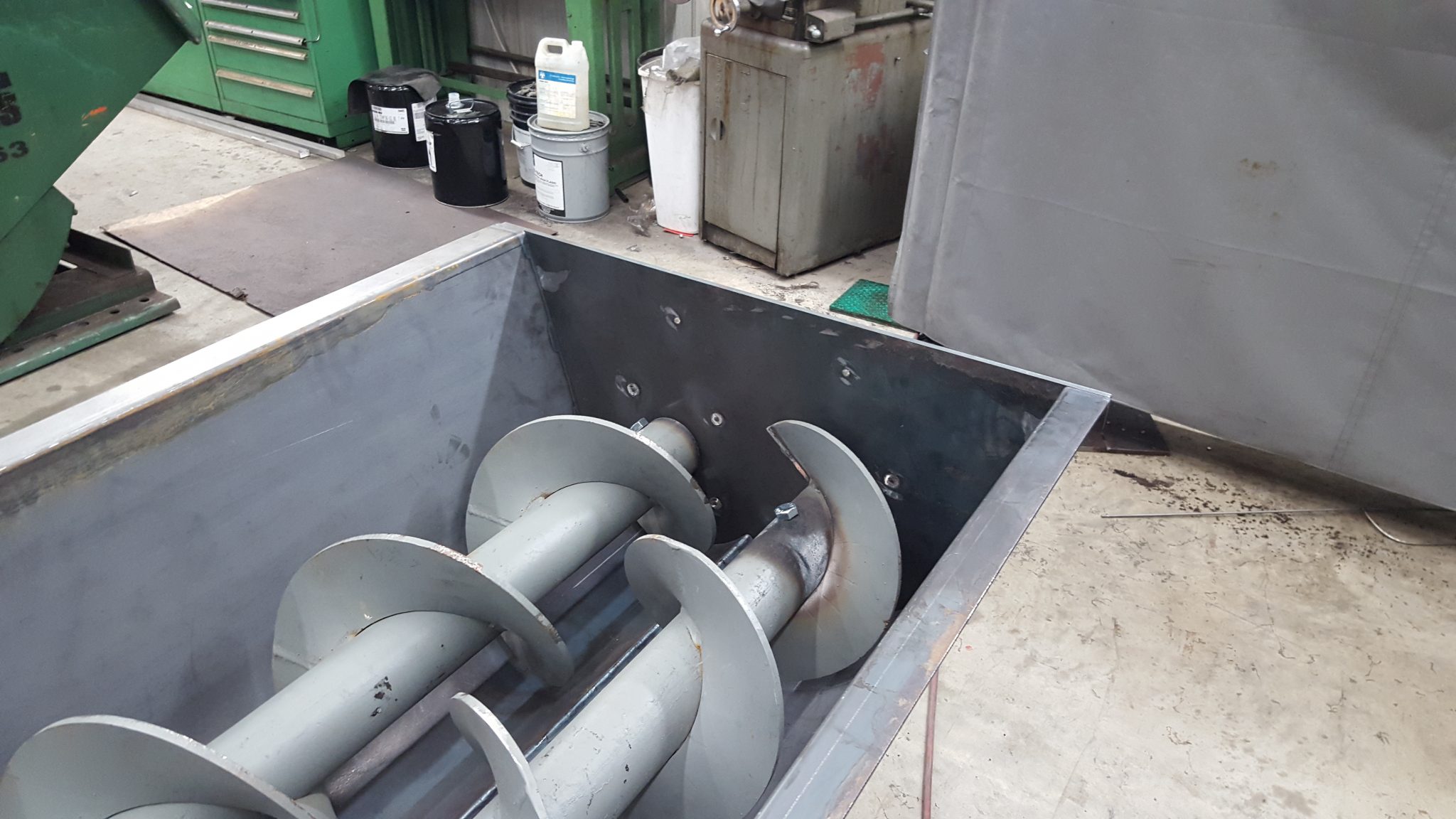
3. Customization Capabilities
Custom equipment is valuable when the standard configuration does not fit the process.
A capable screw conveyor manufacturer should be able to modify the conveyor geometry, construction, drive system, access, mounting, and other features around the application.
Customization can include flight pitch, flight diameter, shaft configuration, trough construction, inlet and outlet locations, drive configuration, speed, thermal capabilities, sanitation features, cleanouts, inspection access, mobility, and mounting.
4. Welding and Fabrication Quality
The quality of the finished screw conveyor depends heavily on fabrication.
The manufacturer should have the equipment, welding capabilities, fabrication experience, and quality controls necessary to produce components that maintain proper fit, alignment, and dimensional accuracy.
This becomes particularly important for custom equipment where components are designed specifically around the application rather than assembled from a standard catalog configuration.
Astro Metal Craft fabricates its custom industrial equipment in-house, providing control over fabrication, quality, and production.


5. Testing and Inspection
Ask how the manufacturer verifies that fabricated components and assemblies meet the requirements of the project.
Depending on the application, inspection can involve dimensional checks, weld inspection, component verification, and review of the finished assembly.
For critical applications, it is also important to understand what documentation and inspection information will be provided with the equipment.
6. Ability to Manufacture Replacement Components
The relationship with a screw conveyor manufacturer should not necessarily end when the equipment is installed.
Flighting, shafts, trough components, bearings, seals, and other components may eventually require replacement due to normal wear or changes to the process.
Working with a manufacturer that understands the original equipment can make future replacement components easier to produce accurately.

Frequently Asked Questions About What Can Be Customized on a Screw Conveyor
➤ Can the manufacturer design around my material?
They should be able to. Screw conveyor design should account for bulk density, moisture, abrasiveness, temperature, flow characteristics, and required throughput. The manufacturer should understand how those characteristics affect flight configuration, conveyor speed, capacity, materials, and drive requirements.
➤ Can they build a conveyor around my existing equipment?
They should be able to work from the process layout and connection requirements. Inlet and outlet locations, available space, mounting points, equipment interfaces, and discharge requirements can all influence the conveyor design.
➤ Can the conveyor be designed for sanitation and wash-down?
Yes, when sanitation is part of the application. A sanitary screw conveyor may incorporate features such as removable components, tool-free or simplified access, cleanouts, appropriate seals, and accessible product-contact surfaces. The specific sanitation features should be selected according to the cleaning process and requirements of the application.
➤ Can the conveyor heat or cool material while conveying?
Yes. Thermal screw conveyors can combine material conveying with heating or cooling when temperature control is part of the process. This can be useful in food processing, biofuel production, and other applications where the material needs to reach or maintain a specific temperature during processing.
➤ Can the conveyor be made mobile?
Yes. A screw conveyor can be mounted to a frame with heavy-duty casters when the process benefits from moving the equipment between locations. Mobility can be particularly useful when facilities have frequent product changeovers, cleaning requirements, or multiple processing locations.
➤ Can the manufacturer provide replacement components later?
This is an important question to ask before purchasing. Components such as flighting, shafts, troughs, bearings, and seals can experience wear over time. A manufacturer familiar with the original equipment may be able to fabricate replacement components based on the original design and operating requirements.
➤ Does the manufacturer fabricate the equipment in-house?
In-house fabrication can provide greater control over production, communication, quality, and lead time. Astro Metal Craft manufactures custom industrial equipment at its own facility rather than treating the screw conveyor simply as a purchased component.
Astro Metal Craft approaches screw conveyors as custom industrial fabrication projects, not simply catalog equipment. Reach out to our team to discuss your next conveyor project.