

Types of Welded Industrial Metal Finishes: What to choose?
In many industrial applications, stainless steel equipment must meet strict sanitary finish requirements to ensure safe and reliable operation.
Achieving these industrial metal finishes typically involves a combination of mechanical and chemical finishing processes, including grinding, polishing, and surface treatment. When performed correctly, these processes produce a smooth, uniform stainless steel surface that resists corrosion and minimizes the risk of contamination in demanding processing environments.
Stainless steel surface finishes are commonly specified for fabricated equipment used in sanitary processing environments such as material handling frames, water treatment tanks, filtration systems, conveyors, and more.
To better understand how these sanitary stainless steel finishes are produced, it is helpful to first define several key terms commonly used in stainless steel finishing and surface preparation.

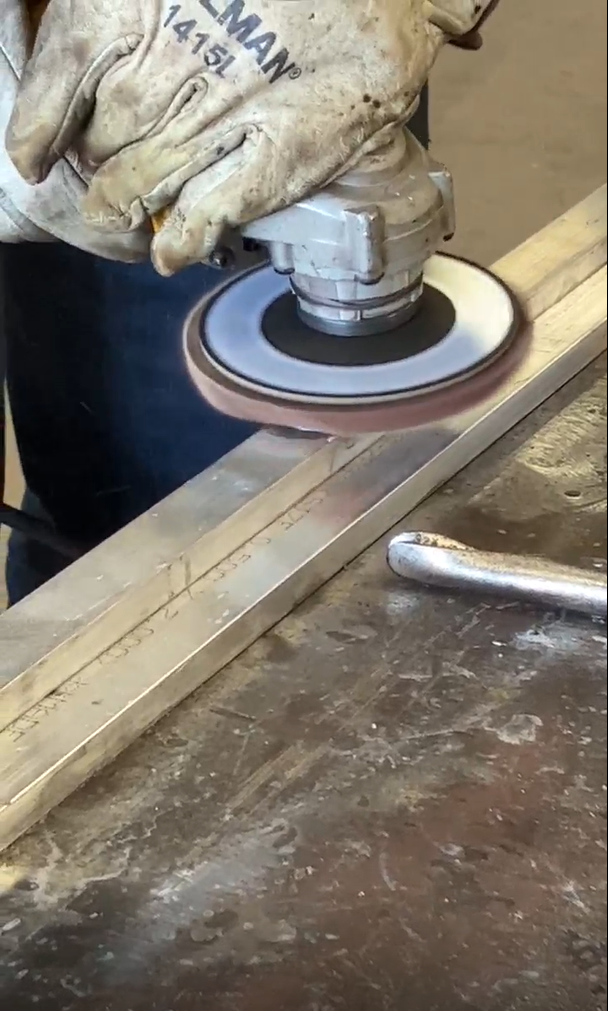

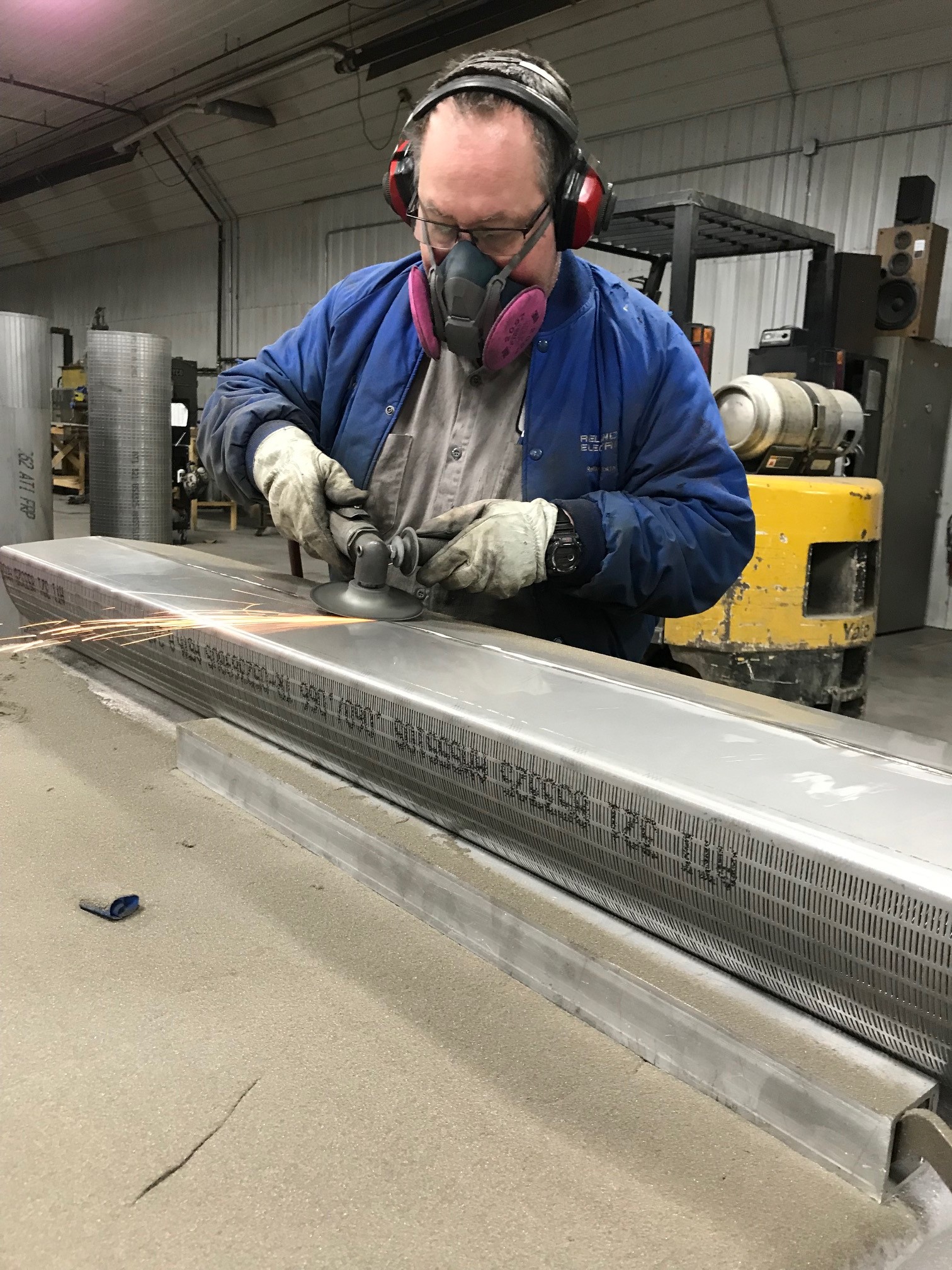

Industrial Metal Finishing- Key Terms
Surface Texture – Refers to the overall irregularities, deviations, and directional grain patterns of the metals surface. Surface texture measures the roughness of the metal and directly influences the functional performance of the fabricated product.
Grit – Describes the particle size of the abrasive media used in surface finishing operations. Lower grit numbers correspond to coarser abrasives typically used in grinding processes, while higher grit numbers indicate finer abrasives used in polishing and fine finishing operations.
Surface Roughness Average (Ra) – A calculation that represents the average height of surface deviations. Ra is commonly used to characterize surface smoothness; lower Ra values indicate a smoother surface, which improves cleanability, corrosion resistance, and sanitary performance.
The materials roughness average (Ra) directly influences the performance of an industrial metal finish. In general, the smoother the metal surface, the more sanitary it becomes. Higher-grit polishing processes produce smoother industrial metal finishes, as the polishing sequence allows for consistent grain direction and weld blending. This reduces the surface roughness average (Ra) and resulting in a clean, sanitary surface.
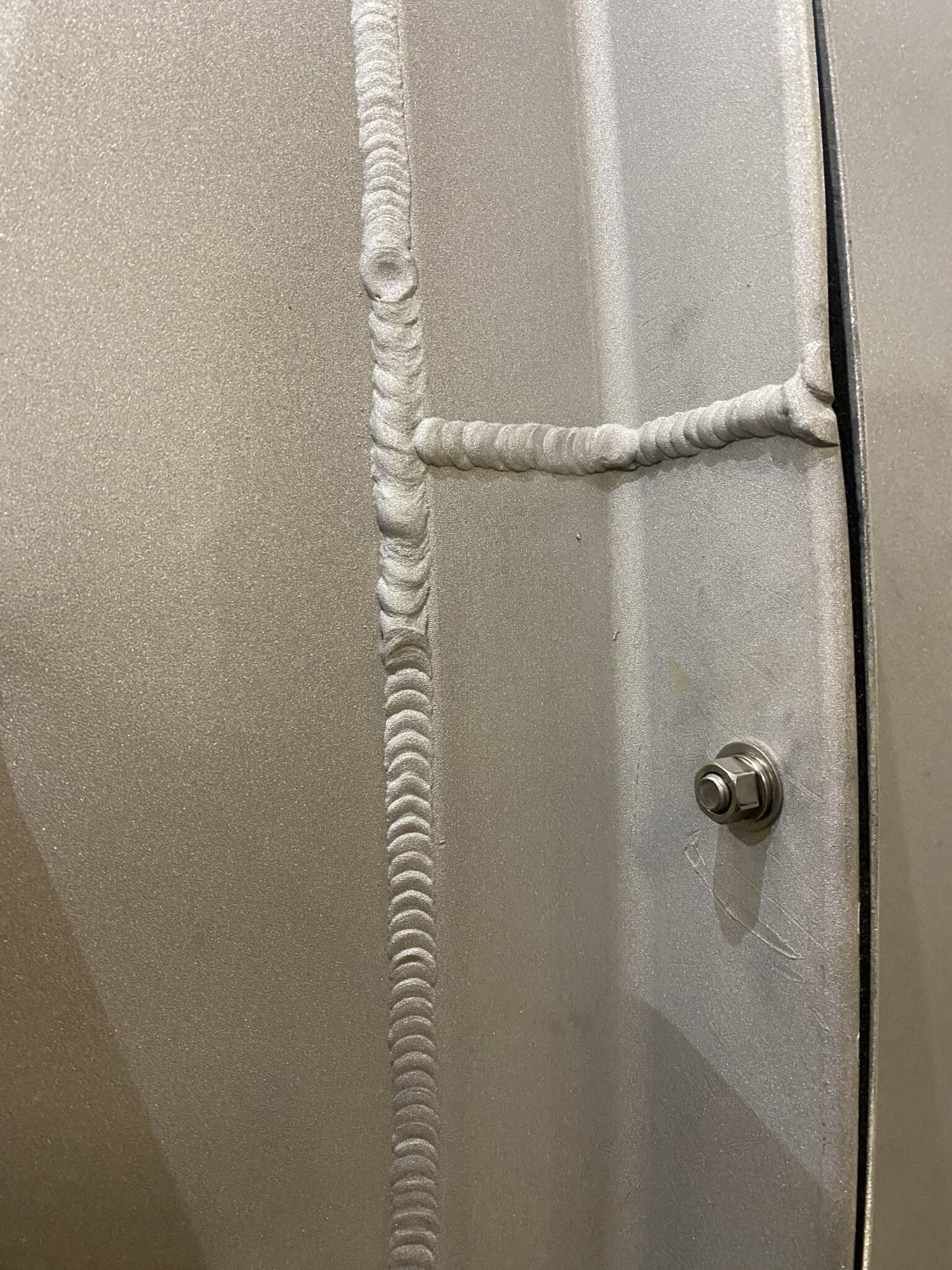
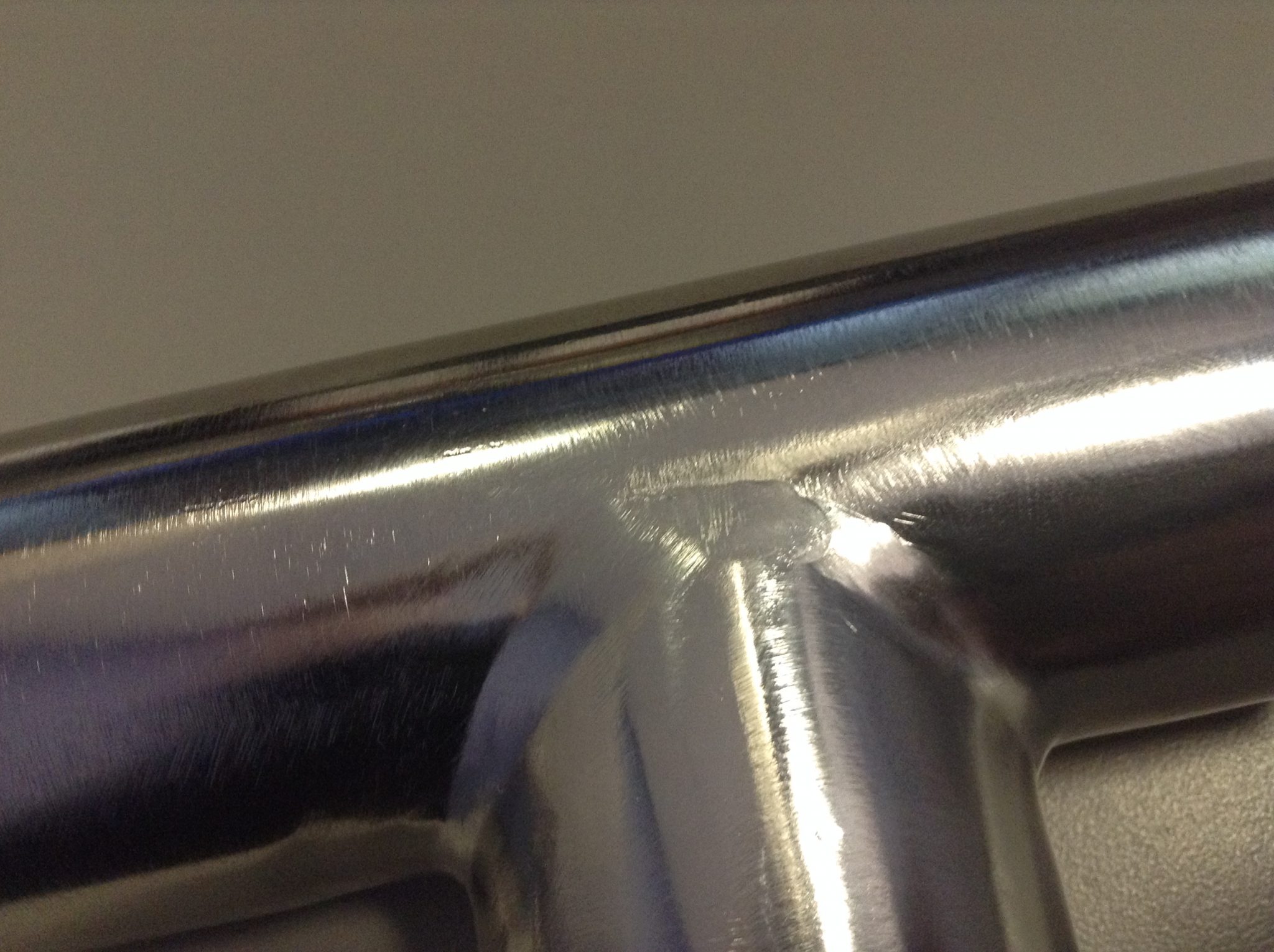
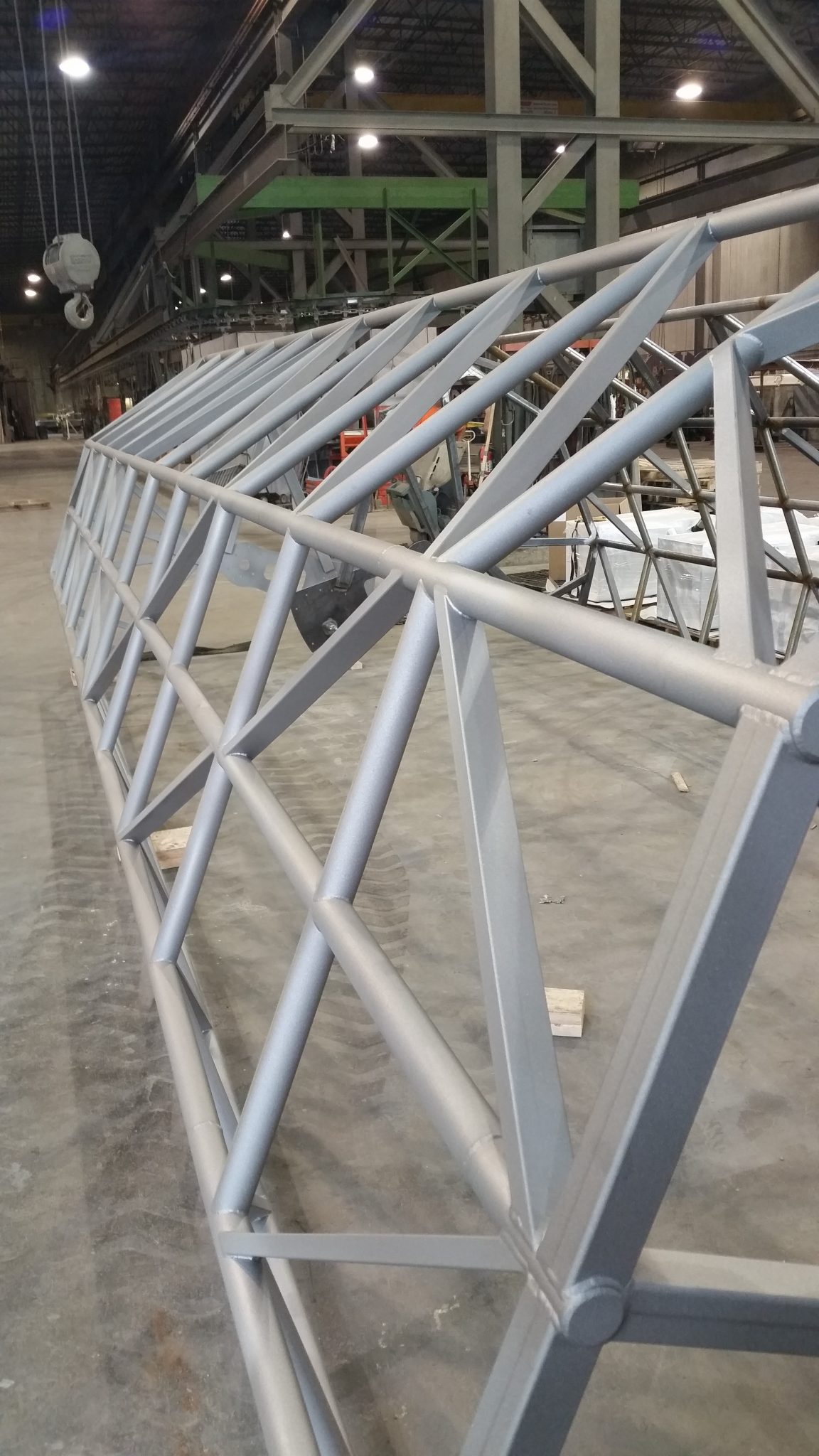

Two Main Types of Finishes
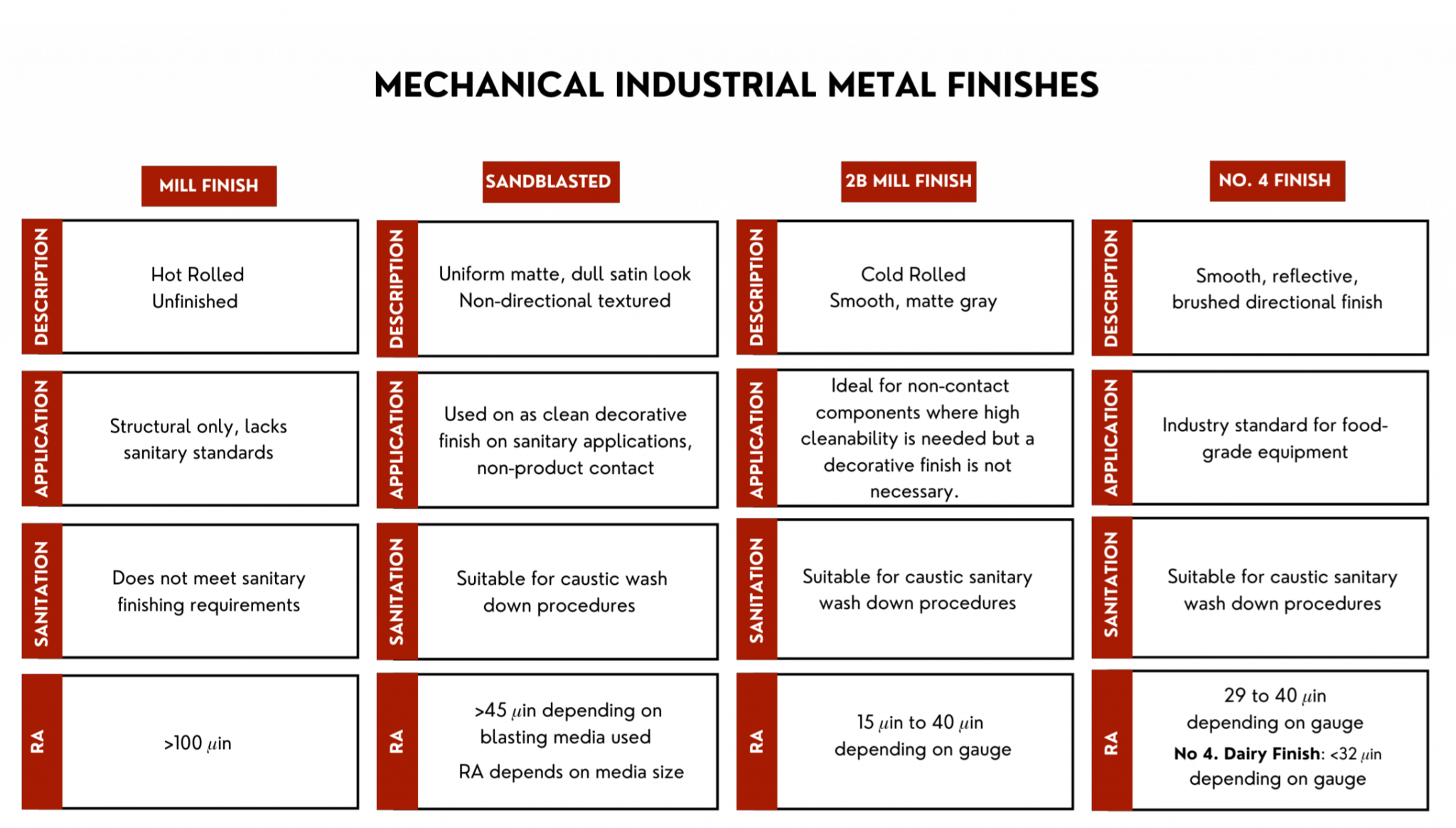
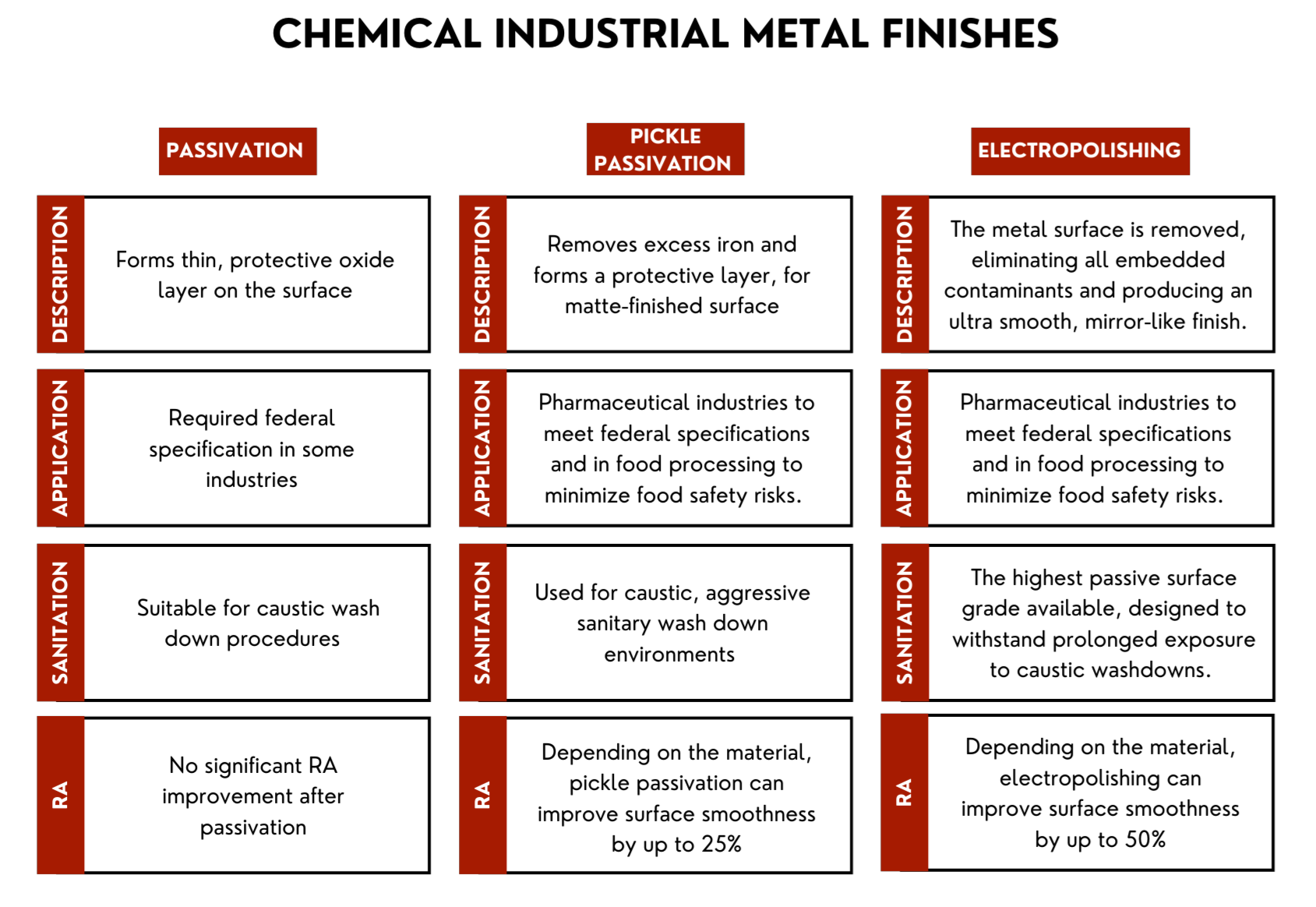
Industrial metal finishing processes for 304 and 316 stainless steel fall into two categories: mechanical and chemical. Below are two charts comparing the similarities and differences between the types of industrial metal finishes.
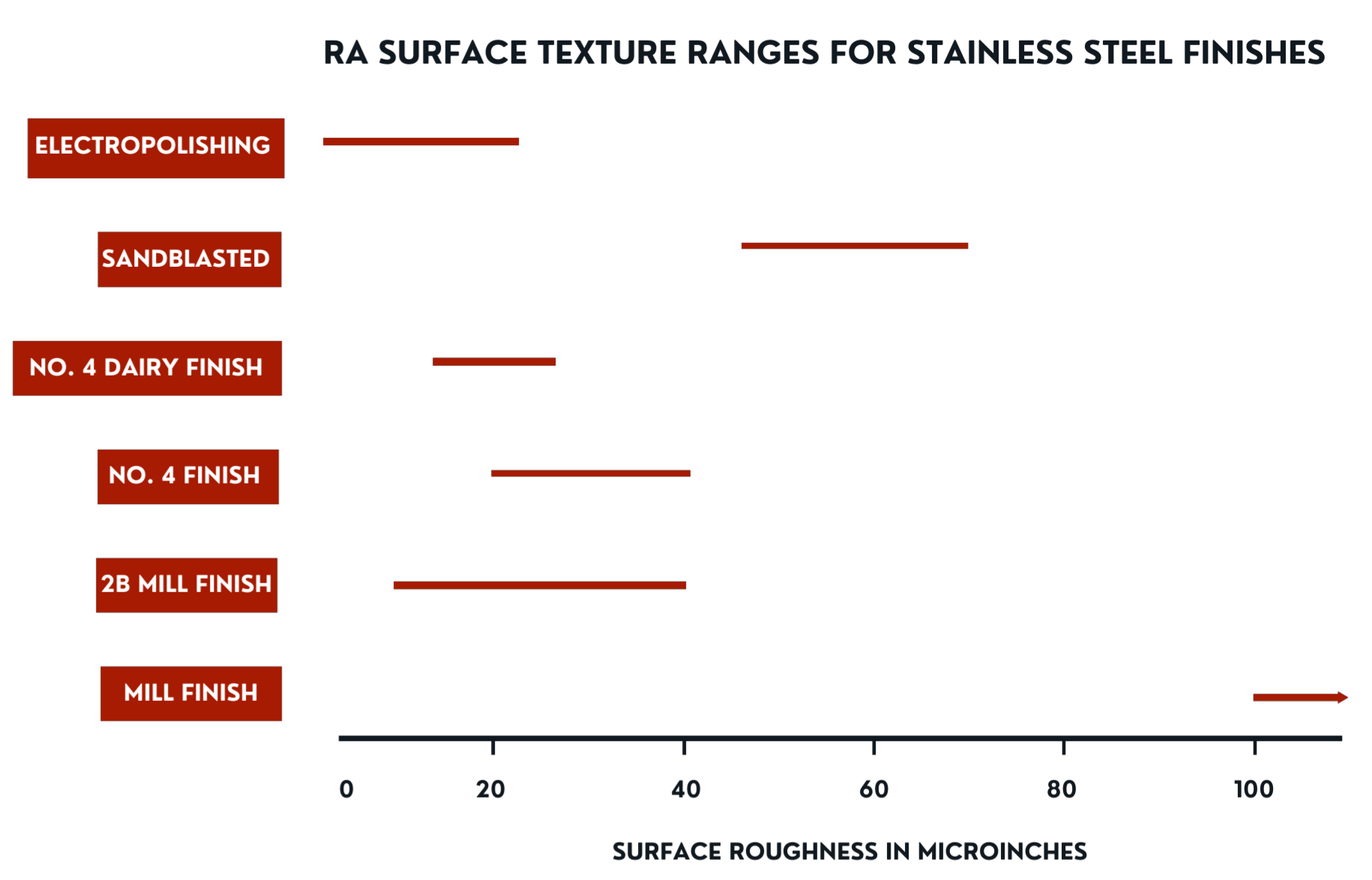
Mechanical finishes: Mechanical polishing involves the removal of material using a grinding process. Four of the most common mechanical fishes include Mill Finish, Sandblasted, 2B Mill Finish, and No. 4 Finish. A No. 4 finish or better is considered the industry standard for the food equipment, dairy and pharmaceutical industries.
Chemical Finishes: Chemical treatments strip away the outer corrosion layer while preserving the underlying integrity of the metal. Three of the most common chemical finishes for industrial equipment include Passivation, Pickle Passivation, and Electropolishing.
Choosing the right industrial metal finishes ensures equipment performs reliably in environments where corrosion resistance and sanitation are critical. Understanding mechanical vs chemical metal finishing processes helps engineers determine which finishing approach best meets the performance and durability requirements of their equipment.
How Fabricators Achieve Sanitary Stainless Finishes
Producing a sanitary stainless steel surface finish requires more than specifying a final polish level. The quality of the finished surface is determined by how the material is welded, how weld seams are treated, the polishing sequence applied during finishing, and the chemical treatments used to restore corrosion resistance.
Fabricators typically achieve sanitary stainless finishes through a controlled process that includes welding, weld grinding, sequential polishing, chemical treatment, and final inspection.
1.Welding
The foundation of a sanitary finish begins with proper welding practices. Poor weld quality introduces irregularities such as excessive reinforcement, undercut, spatter, and heat discoloration that significantly increase the amount of finishing required and may compromise cleanability.
In fabricated equipment such as tanks, frames, and process skids, welds must be executed with precision. Proper welding parameters help control distortion, surface irregularities, and reduce the size of the heat-affected zone. This makes it easier to achieve a uniform final finish.
Quality weldments are completed in accordance with AWS D18.1/D18.1M:2020 Specification for Welding of Austenitic Stainless Steel Tube and Pipe Systems in Sanitary (Hygienic) Applications. Every weld must be performed by a qualified welder and inspected by a Certified Welding Inspector (CWI) to ensure structural integrity and compliance with sanitary fabrication standards.
2.Weld Grinding and Bead Blending
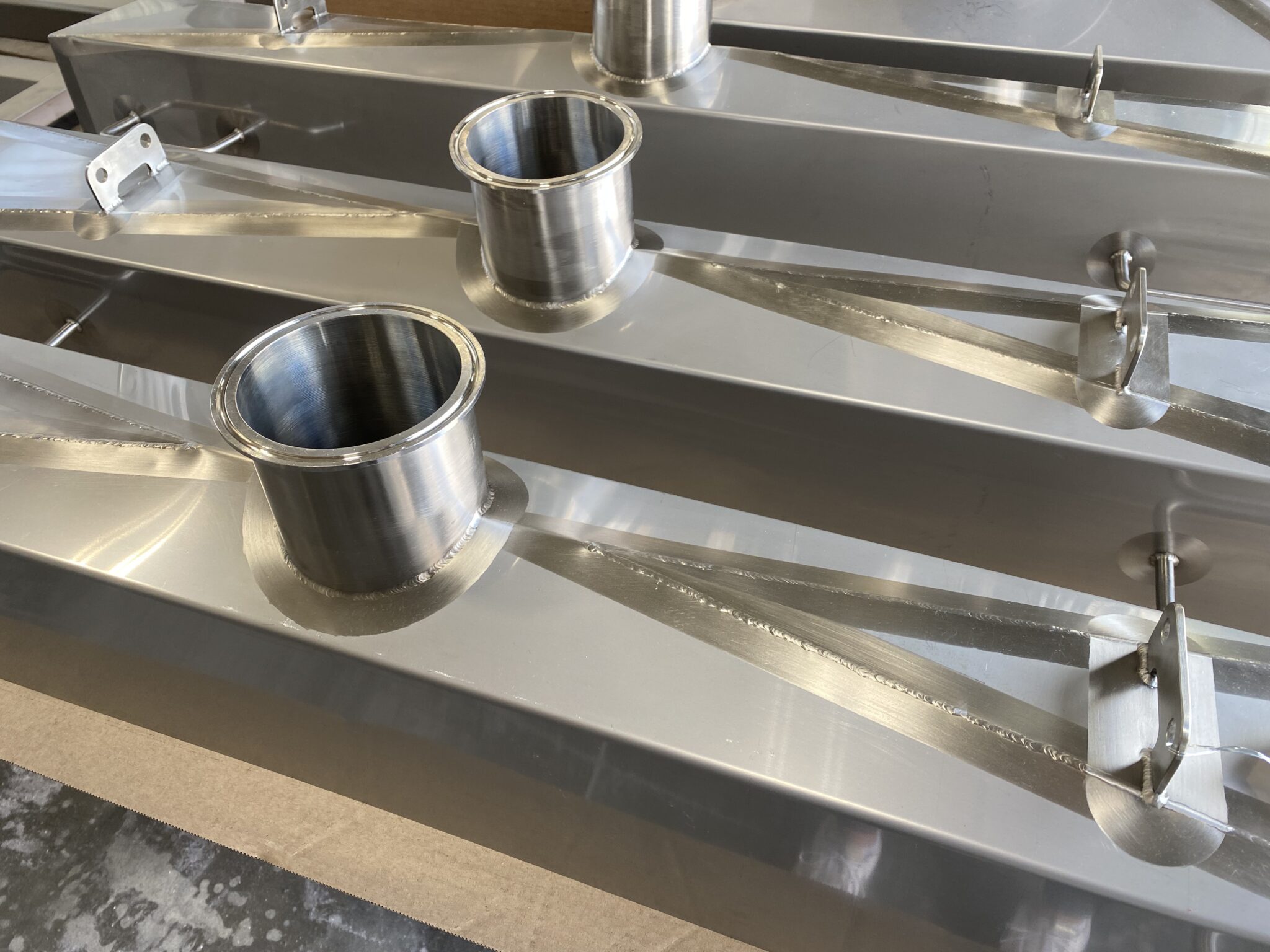
During fabrication, specialized weld blending and polishing techniques are used to ensure welded joints transition smoothly into the surrounding stainless steel surface.
Even when the base material meets the required surface finish, untreated weld seams can introduce roughness, crevices, or surface transitions where product residue or bacteria may accumulate. Proper weld treatment eliminates these irregularities and ensures the weld zone maintains the same cleanability as the surrounding metal.
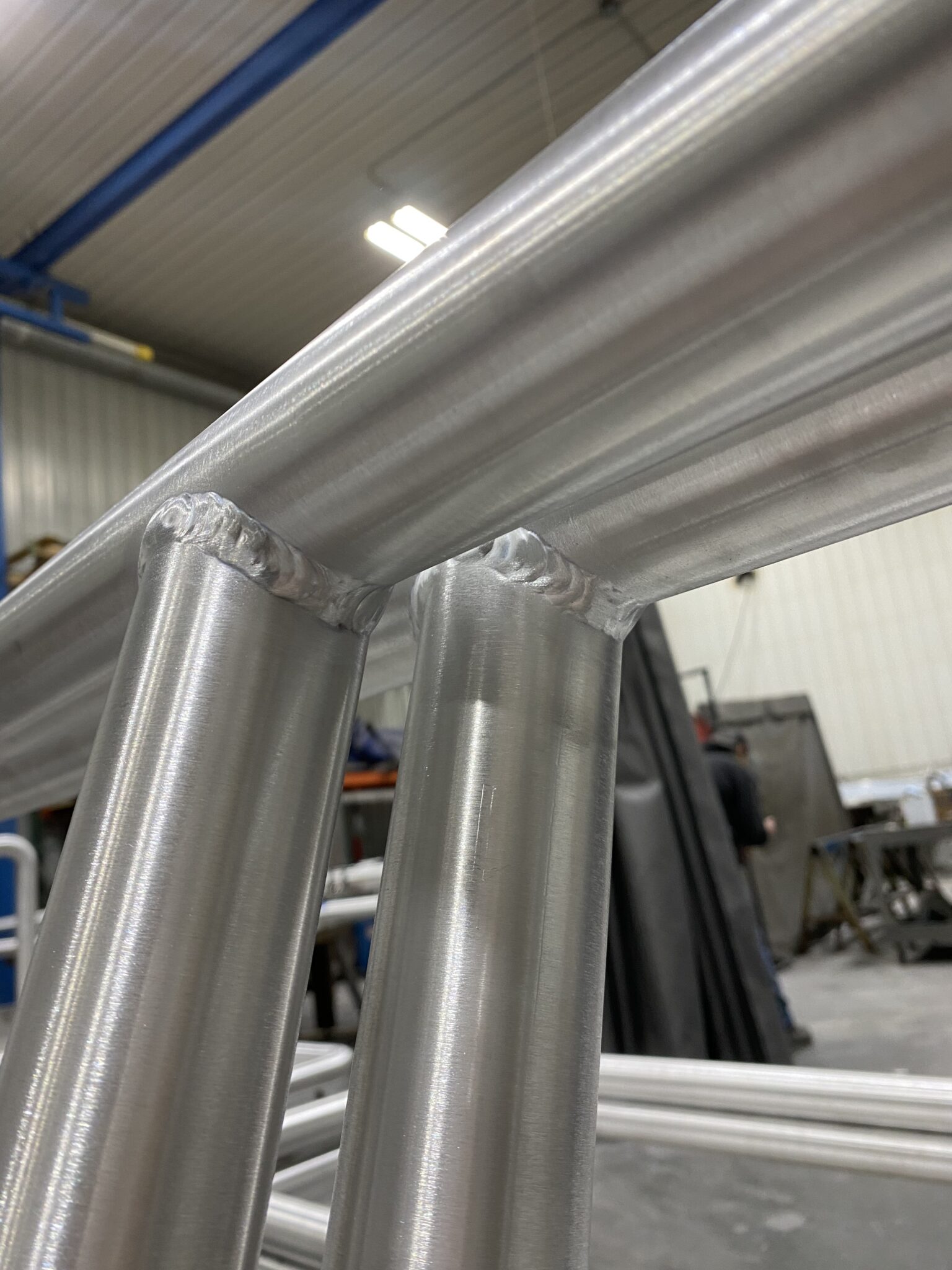
The first step is weld grinding and bead blending. Excess weld reinforcement is carefully ground down and blended into the surrounding surface so the weld does not create ridges, undercut areas, or abrupt transitions. The goal is not simply to remove the weld bead, but to produce a smooth, continuous surface profile that matches the surrounding base material.
Surface transition control is critical at this stage. The weld area and adjacent metal must transition smoothly without visible halos, dips, or texture differences. Achieving this requires controlled grinding techniques that extend beyond the weld seam to maintain a consistent surface profile.
3. Polishing Sequence
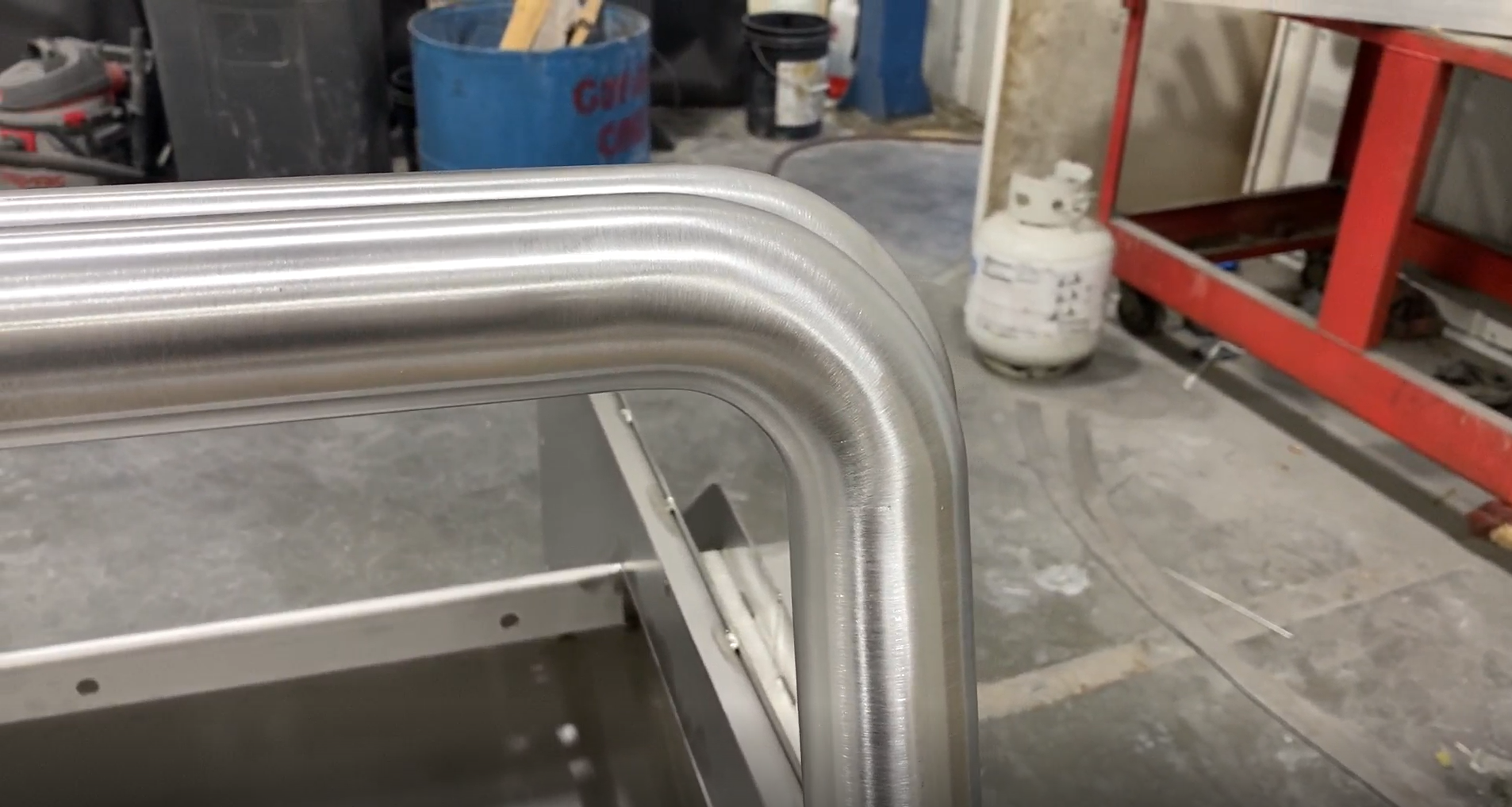
Achieving a consistent sanitary surface often requires polishing welded stainless steel surfaces through a controlled abrasive progression that refines the metal until the specified surface roughness is achieved. Sanitary finishes are typically produced through a progressive abrasive sequence, where each step refines the surface and removes scratches from the previous grit.
A common sanitary polishing sequence may include:
- 80 grit – weld blending
- 120 grit – surface leveling
- 180 grit – grain formation
- 240 grit – final polish
Each stage progressively smooths the metal surface and reduces the surface roughness average (Ra) until the specified finish is achieved. After the weld area is blended, finishers re-establish the grain pattern so it runs consistently across the weld seam and adjacent surfaces. This ensures the weld zone has the same scratch pattern and surface roughness characteristics as the rest of the assembly.
For example, in stainless steel tanks used for food or dairy production, interior weld seams can be ground flush and polished to the specified surface roughness so product residue cannot accumulate along the weld line. Fabricators typically blend these welds into the surrounding shell material using progressive abrasive steps before restoring the directional grain pattern across the tank interior.
4. Chemical Treatment
During welding, stainless steel is exposed to elevated temperatures that cause oxidation around the weld seam. This discoloration, commonly known as heat tint, forms when the protective chromium oxide layer on the stainless surface is disrupted.
Heat tint is more than a cosmetic issue. For example, when welding stainless steel tanks or food processing equipment, the heat generated during welding commonly produces visible heat tint along the weld seam. If this oxide layer is not properly removed, the affected area may have reduced corrosion resistance and may respond differently during polishing compared to the surrounding base material.
To address this issue, fabricators remove heat tint using either chemical or mechanical methods.
Chemical treatment often involves applying pickling paste, which dissolves the oxide layer and restores the chromium-rich surface that provides stainless steel with its corrosion resistance. Mechanical removal may also be used, including stainless brushing, abrasive conditioning discs, or fine grinding to remove the discolored layer before final finishing.
After heat tint removal, passivation treatments are commonly applied to further restore the protective chromium oxide layer on the stainless surface. Fabricators adhere to the ASTM A967 and ASTM A380 stainless steel weld finishing standards when passivating to remove impurities and prevent corrosion.

5. Inspection and Finish Verification
The final stage in industrial metal finishes are inspection and verification that the surface meets the specified requirements.
This includes confirming that weld seams are fully blended, the surface grain pattern is uniform, and no visible defects such as scratches, pits, or texture inconsistencies remain. Inspectors also verify that the surface roughness meets the specified Ra (surface roughness average) for the application.
In sanitary fabrication, careful inspection ensures that the finished stainless surface provides the smoothness, corrosion resistance, and cleanability required for hygienic process equipment.

Industrial Metal Finishes FAQ
What Ra (surface roughness average) is required for sanitary applications?
Ra of 32 𝜇in (0.8 𝜇m) or lower is considered sanitary. The metal surface must be polished smooth enough that the average microscopic roughness does not exceed 32 𝜇in (0.8 𝜇m). Lower Ra measurements are often specified and can be achieved through further finishing processes.
How do welds affect the final surface finish?
Weld quality plays a vital role in achieving a smooth, compliant final surface finish—especially in sanitary applications. When welds are executed with precision and properly finished, concerns such as spatter, oxidation, heat tint, penetration, and bead consistency are effectively controlled, ensuring the surface meets hygienic standards with confidence.
At Astro Metal Craft, our industrial welds are completed in accordance with AWS D18.1/D18.1M:2020 Specification for Welding of Austenitic Stainless Steel Tube and Pipe Systems in Sanitary (Hygienic) Applications. Every weld is performed by a qualified welder and inspected by a Certified Welding Inspector (CWI) to ensure structural integrity, proper finish, and full compliance with sanitary requirements.
Does higher grit polishing significantly increase cost?
Yes. Higher grit polishing will increase fabrication costs due to additional finishing steps, labor time, and material consumption.
In many fabrication projects, weld inconsistencies can significantly increase finishing time. For example, a weld with excessive reinforcement may require several additional grinding and polishing passes before the area can be blended into the surrounding stainless surface.
That being said, finishing expenses can be managed strategically. High-grit finishes should be specified only where function or aesthetics truly require them. Partnering with an experienced fabricator helps minimize costly rework, particularly from weld inconsistencies that can significantly increase finishing time.
How do I choose the right industrial metal finishes for sanitary or food-grade environments?
Sanitary industrial metal finishes typically require a surface roughness of Ra ≤ 32 𝜇in. The specific finishing method used to achieve this standard depends on the base material, material gauge, and the abrasive grit sequence applied during finishing.
At Astro Metal Craft, we specialize in high-quality stainless steel and aluminum fabrication. Our team understands the unique characteristics of these specialty metals and applies the appropriate finishing processes to meet sanitary code requirements.
Are industrial metal finishes applied before or after fabrication and welding?
Industrial metal finishes will be applied after fabrication and welding to ensure a clean, uniform surface. Welds are typically blended through controlled grinding to eliminate surface irregularities and create a smooth transition. Chemical treatments such as pickling and passivation are then used to remove heat discoloration and free iron, restoring the protective chromium oxide passive layer that gives stainless steel its corrosion resistance. When an even higher level of refinement is required, electropolishing is performed to further enhance surface smoothness and cleanliness.
Interested in fabricating a custom industrial product? Reach out to us today!