
Industrial Weld Fabrication Best Practices
We recently spent some time in the shop with Mitch, one of Astro Metal Craft’s experienced welders, talking about what goes into producing high-quality welds. From welding stainless steel and aluminum, to overcoming real-world fabrication challenges and improving shop drawings before production begins, Mitch shared practical insights drawn from years of hands-on experience.
Why Industrial Weld Fabrication of Stainless Steel and Aluminum Require Specialized Expertise
Many industrial systems rely on stainless steel and aluminum because of their corrosion resistance, strength-to-weight ratio, and sanitary elements. However, both materials require significantly more process control than carbon steel or other alloys.
Stainless Steel
Heat management is one of the biggest challenges when welding stainless steel. Excessive heat input enlarges the heat-affected zone (HAZ), increases distortion, and can reduce corrosion resistance by altering the chromium-rich surface that gives stainless steel its protective properties.
Maintaining the proper travel speed, amperage, and welding sequence helps preserve the material’s mechanical properties while producing sound, consistent welds.
Aluminum
Aluminum behaves very differently than steel. Its high thermal conductivity requires precise heat control to achieve proper penetration without overheating the material. Aluminum quickly forms a thin oxide layer when exposed to air. Because this oxide melts at a much higher temperature than the aluminum beneath it, proper surface preparation is essential to achieve a sound weld.
Even small amounts of oil, moisture, or abrasive contamination can introduce porosity and reduce weld quality.
At Astro Metal Craft, aluminum components are cleaned with acetone prior to welding, filler material is kept clean, and abrasive contamination is carefully controlled throughout the fabrication process. These preparation steps help produce strong, repeatable welds while minimizing defects in industrial weld fabrication.
Industrial Weld Fabrication: What Makes a High-Quality Weld?
Weld quality is much more than physical appearance.
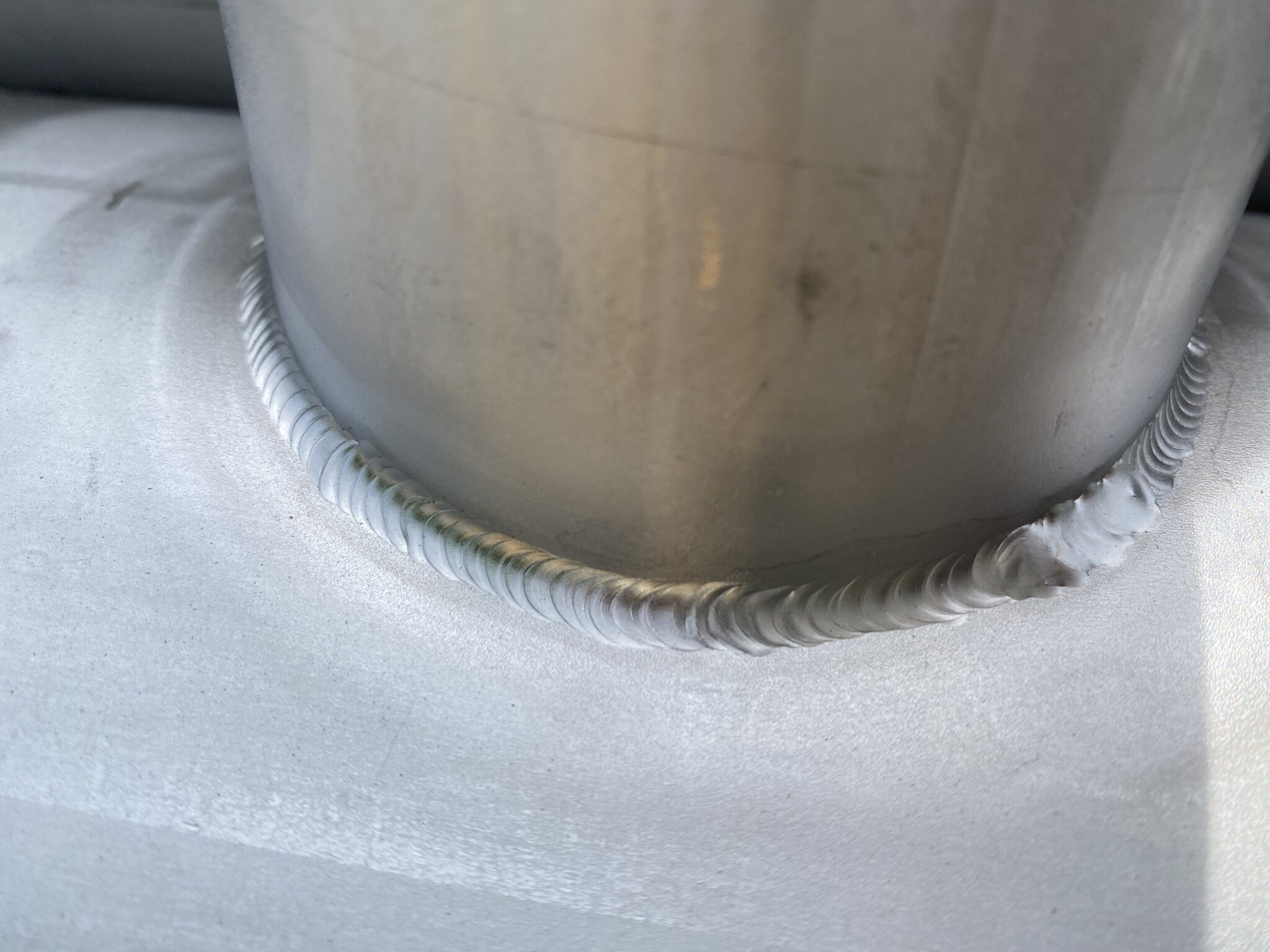
A weld can appear flawless on the surface while hiding defects that lead to premature failure once the final product is in operation. In industrial weld fabrication, incomplete penetration or lack of fusion can become failure points under cyclic loading, vibration, pressure, or repeated thermal expansion. Producing a sound weld requires achieving full fusion between the base materials while maintaining the mechanical properties specified for the application.
All welds must compile to American Welding Society (AWS) requirements and are evaluated for factors including:
- Complete joint penetration
- Proper fusion between base metals
- Porosity and contamination
- Cracking or underfill
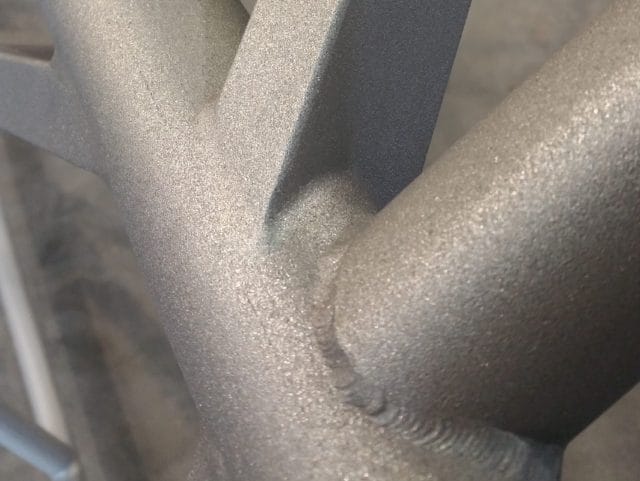
- Consistent weld profile
- Heat input appropriate for the material and application
Depending on customer specifications, weld quality may be verified through visual inspection, dimensional inspection, dye penetrant testing, or other nondestructive testing (NDT) methods to ensure compliance with project requirements.
Custom Fabrication Requires Adaptable Welders
Unlike high-volume manufacturing, custom fabrication rarely manufactures the same design twice.
A welder may be TIG welding sanitary stainless steel piping one day, then transition to aluminum structural assemblies the next. Each material, joint configuration, and application requires different techniques, welding parameters, and quality standards.
That versatility is especially valuable when fabricating engineered industrial equipment, where every project presents unique challenges.
Just as important is understanding the downstream manufacturing process. Producing welds with proper fit-up and controlled reinforcement reduces grinding, minimizes distortion, and improves assembly efficiency. The result is higher-quality fabrication, shorter production times, and equipment that’s built to perform reliably in the field.
What Happens When Shop Drawings Don’t Meet Reality?
Every fabricator has experienced it – a design looks great on paper, but once it reaches the shop floor, something doesn’t quite work the way it was intended.
A weld joint that seemed accessible in the CAD model is blocked by another member. A connection is tucked into a corner where a TIG torch simply won’t fit. Or a weld sequence that looked straightforward creates distortion once the assembly is fully fixtured.
These are the kinds of real-world fabrication challenges that welders face when they begin building equipment.
At Astro Metal Craft, our welders don’t work around these issues. They work alongside our project managers to evaluate the situation, determine the best solution, and communicate with the customer whenever a design modification is needed. This close collaboration helps prevent costly rework and keeps projects moving efficiently.
Designing with Fabrication in Mind
The best fabrication projects start with designs that consider not only how the equipment will function, but also how it will be built. This approach is often referred to as Design for Manufacturability (DFM). DFM involves reviewing assemblies before production begins to identify inaccessible welds, difficult fit-up conditions, excessive distortion risk, or opportunities to simplify fabrication.
A common example Astro encounters is when welding industrial structural frames. On a drawing, frame channels placed one inch from the inside wall may appear perfectly acceptable. In the shop, however, there may not be enough clearance for the welding torch to achieve the specified weld without compromising access or quality.
When situations like this arise, our team works with the customer to identify the best path forward. Depending on the application, that may involve:
- Adjusting the joint design to improve welding access.
- Revising the weld sequence to reduce distortion or improve accessibility.
- Using an alternate sealing method when corrosion protection is required but a continuous weld isn’t practical.
Every decision is based on the application’s structural loads, service environment, corrosion requirements, inspection criteria, and the customer’s performance expectations. The earlier these conversations happen, the smoother fabrication becomes.

The Astro Advantage
When you’re building custom industrial equipment, you’re trusting your fabrication partner with more than a drawing. You’re trusting them to identify potential manufacturing challenges, communicate solutions early, and deliver assemblies that perform exactly as your design intended.
That’s why fabrication at Astro Metal Craft is a collaborative effort from start to finish.
Our fabrication team works together throughout to verify manufacturability, resolve issues before they impact production, and maintain the quality standards our customers expect. When questions arise, they don’t sit on the shop floor. They are communicated quickly, so the right solution can be implemented before fabrication moves forward.
That level of collaboration is supported by continued investment in our capabilities. Over the years, we’ve expanded our welding operations, upgraded equipment, strengthened our quality systems, and built a team with the experience to tackle complex custom fabrications across stainless steel, aluminum, and other alloys.
At Astro Metal Craft, we see ourselves as an extension of our customers’ engineering and manufacturing teams. By combining experienced project management, skilled fabrication, and open communication, we help customers turn designs into reliable, production-ready assemblies that are built to perform in the field.
These fabrication principles apply across a wide range of industrial equipment including conveyors, process piping, structural frames, material handling equipment, tanks, pressure vessels, access platforms, and custom process skids.